
Аrticle
June 16, 2026
Responsible gambling guide for operators and providers: compliance, tools, and strategies


Responsible gambling is one of the core tenets of iGaming. It’s important for every provider, aggregator, and operator. Good responsible gambling protocols keep players safe, while failure to comply could result in fines and even license suspensions.
It’s mandatory. Not optional. And in this guide, we’ll discuss key tools and responsible gambling best practices to help you stay compliant and keep your players safe.
What is responsible gambling?
Gambling is inherently risky. Casino games are designed with a house edge, meaning players are expected to lose money over the long term. Without proper guidance and tools, some players could lose so much that they risk their financial security.
The concept of responsible gambling is to create a space where players are encouraged to play safely and have fun. Gambling is a form of entertainment, after all, and if some players are losing too much and getting frustrated, they’re not having fun.
Responsible gambling guidelines are used throughout the online gaming industry, primarily because regulatory authorities require operators to follow strict rules, but also because players see responsible gambling sites as more trustworthy. Operators also want to protect their players and ensure they enjoy themselves.
According to the World Health Organization, around 1.2% of the global adult population has a gambling disorder. These players take more risks and can do serious harm to their finances and mental health. They may, for example, gamble more than they can afford to lose, chase losses, hide their activities from loved ones, and borrow money to gamble.
By teaching people how to gamble responsibly, both B2B and B2C platforms can reduce these harms and protect problem gamblers.
At-risk groups and how an iGaming business can protect them
Younger players are more at risk of problem gambling. They are often exposed to free-to-play social casino games, including those available on social media, and are less likely to see real-money casinos as high risk.
Experts are also concerned about potential risks in older adults. As we get older, our cognition slows. Our memory fades. We become less adept at facing challenges and finding logical solutions.
Problem gambling is often closely associated with mental health issues, particularly depression, and drug/alcohol misuse. It becomes a vicious cycle. Players take greater risks because they’re depressed; they lose money, and that makes them even more depressed.
Finally, the risks of gambling are greater in those with a lower socioeconomic status. In other words, those who can least afford to gamble are often the ones who gamble the most.
Basic responsible gambling policy and how it’s implemented
By offering responsible gambling tools and providing responsible gambling tips, operators can meet licensing requirements, protect their brand's reputation, and provide a safe environment for players.
Operators can protect their players by promoting awareness and implementing the following principles of responsible gaming:
Protect players and encourage fairness and transparency
Whether they’re playing slot machines like Wish & Spin Fortune and Classic Chilli Hold and Win or table games like roulette and blackjack, players must be able to check the RTP/house edge, and know the game uses a certified RNG.
Payouts and odds should be explicitly stated; bonus terms should be easy to understand, and players need to know that their transactions are safe and their gaming activity is fair.
Using responsible gambling tools
Players can use tools like deposit limits as part of responsible gambling strategies, such as setting a monthly limit that aligns with their bankroll. These tools also prevent reckless, impulsive gambling.
Prevent underage gambling
Not only are underage players more exposed to the risks of gambling, but it’s also illegal for anyone under the age of 18 to gamble in most jurisdictions.
iGaming operators utilize various age verification mechanisms to prevent underage players from accessing their platforms, including Know Your Customer (KYC) checks that verify all players’ identities.
Key responsible gambling tools and how they work
iGaming operators have a number of responsible gambling tools at their disposal. Some of these work in the backend to detect high-risk activity; others are offered to players to help them control their actions:
Know your customer (KYC) and anti-money laundering (AML) checks
As noted above, KYC checks are key age verification mechanisms used to prevent underage gambling. AML checks focus more on fraud and money laundering. Combined, these protocols can flag suspicious behavior.
By conducting a KYC/AML check, operators can confirm the name, age, and location of an individual. They can then flag sanctioned entities or PEP (politically exposed persons) who may be using the platform to launder money. They can also combat fraud by ensuring an individual’s name and location match the details on their payment method.
As the industry grows and incorporates machine learning technology, AML/KYC systems are becoming more advanced and more adept at flagging PEPs, fraud, suspicious behavior, and problem gambling.
Player limits
With deposit limits, players place a self-imposed cap on their own daily, weekly, or monthly deposits. With wager limits, those caps apply to their total wagers. Reductions take effect immediately, but increases take at least 24 hours, thus preventing impulsive activity.
Self-exclusion and time-outs
A time-out is a self-imposed break, usually for a period of several weeks or months. The players choose the timeframe themselves, and can’t access the platform until that period expires.
A self-exclusion works in a similar way, but with more restrictions and longer exclusion times.
Reality check tool
A key part of any responsible gambling framework, a reality check is a simple but effective tool that reminds players how long they have been active.
It’s easy to get caught up in the action, and players may find themselves gambling for longer than intended. A reality check tells them exactly how long they have been gambling, and may also show them how much they have wagered/lost in that time.
How operators use technology to follow responsible gambling rules
Machine learning (ML) and artificial intelligence (AI) have been instrumental in helping operators to follow responsible gambling best practices.
Problem gamblers tend to exhibit telltale behaviors. They may bet quickly and race through slot machine results. They may also increase their bet sizing considerably in a short space of time, or repeatedly set and cancel deposit limits.
AI algorithms trained on this behavior monitor player activity to look for patterns of problem gambling. The algorithm then raises a concern with the operator. Armed with this information, the operator can inspect the player’s activity manually and then consult with the player or implement certain limits.
These early warning systems prevent players from taking bigger risks and losing more money, while ensuring the operator stays compliant. What’s more, as the technology improves, the algorithms become more efficient at separating regular gambling from problem gambling and can detect the warning signs earlier than before.
There are also AI systems that account for the player’s customer support interactions. Again, they look at previous patterns to detect future ones, such as increased player frustration or anger, as well as repeated requests for changes in problem gambling tools.
Responsible gambling practices: What are the rules?
Operators don’t rely entirely on AI. It’s not infallible. It makes mistakes. Those mistakes could cost an operator dearly, so they must adopt a multi-faceted approach.
Here’s how casinos follow responsible gambling rules:
- Providing tools and education: Although the rules differ by regulatory authority, responsible gambling guidelines often require operators to have a dedicated responsible gambling page. It should include helpful information and resources, as well as guides on how to use deposit limits, self-exclusions, and other such tools.
- Training their staff: Whether it’s an online casino or sportsbook, staff members should be trained on the risks of problem gambling and should know how to respond to individuals who request more information or show clear signs of problem gambling.
- Offering support services: There are various helplines and counseling services devoted to problem gambling. Responsible operators should list these clearly on their website and direct problem players to them when needed.
- Detection and intervention: While AI tools can detect problem gambling, the casino needs to know when and how to intervene. This can range from prompting the player to gamble responsibly to initiating a source of funds request or even blocking their account.
What are responsible gambling practices in specific regions?
Regulatory authorities adopt their own approach to responsible gambling, and it can differ considerably from one region to the next.
In the United Kingdom, for example, licensing requirements stipulate that operators must:
- Provide clear responsible gambling information to all players.
- Protect vulnerable groups from using their platform.
- Implement tools such as player limits, reality checks, self-assessments, and activity statements.
- Provide third-party links to helpful resources.
In Sweden, authorities prevent operators from offering any bonuses other than an initial welcome bonus.
Other jurisdictions may adopt a more relaxed approach to the issue, but if an operator has multiple licenses and targets various regions, they need to abide by the laws in all of them. It makes for complicated responsible gambling policies. However, by initiating strict protocols across the platform, they can target all jurisdictions and create a safe space for everyone.
Keeping your players safe: Responsible gambling tips 2026
Every responsible operator should provide their players with helpful responsible gambling tips. It shows that they care, encourages player loyalty, and ensures regulatory compliance.
Here are some helpful responsible gambling tips for online casinos:
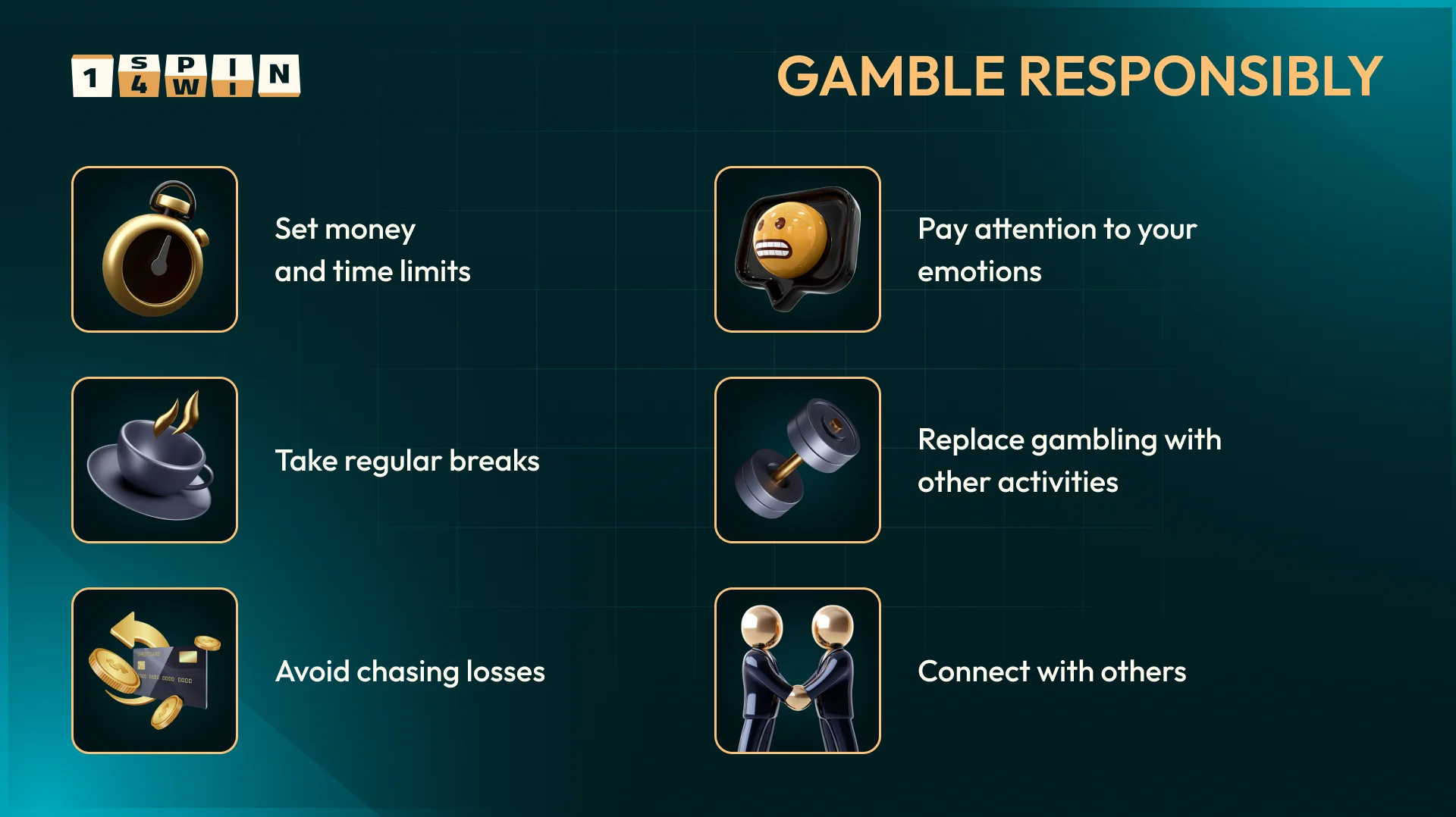
- Set a budget: Encourage players to create a budget/bankroll, ensuring they only risk what they can afford to lose.
- Use tools: Deposit limits help players stick to a budget. Player notifications and time limits prevent prolonged gambling. Time-outs force them to take a break when they sense they have a problem. Offer all of these and encourage their use.
- Seek help: If a player is struggling, they should be directed to support services. They should also seek help from loved ones.
- Take a break: When players get frustrated, angry, or tired, it’s time for them to take a break. Remind them of this fact, as failure to do so will greatly increase their risk.
- Learn the basics: Every player should know how to read an RTP in slots and a house edge in table games. They should know that RNGs are random and each game/spin is independent. Knowledge goes a long way in teaching them how to gamble online responsibly.
Helpful resources and support services to show your players
There are helpful organizations that support problem gamblers in all jurisdictions. Some are online only and, therefore, assist players all over the world.
While providing helpful tools and information, make sure you include a list of specialized organizations, such as:
- BeGambleAware—A UK-based problem gambling support agency.
- GamCare—The founder of the National Gambling Helpline.
- GamStop—A service that excludes players across a network of sites.
- Gamblers Anonymous—A recognized support group with meetings all over the world.
- National Council on Problem Gambling—A US-based nonprofit dedicated to problem gambling.
- Gordon Moody—A resource offering counseling, online support, and advice.
How we support responsible gambling at 1spin4win
The 1spin4win slot provider dedicates time and resources to encouraging safe and responsible gambling within the online gambling industry. We list key details on all our games to encourage transparency, and some of our games offer RTPs of up to 97.2%, which is above the average for many online slot games, such as the 97.2% ratings on both Cash’n Spins 27 Plus and Lucky and Brave Fortune.
We offer our partners various promo tools geared toward responsible promotions, and cover key aspects of responsible and fair gaming in our blog, including our guide to provably fair technology and the inner workings of a random number generator (RNG).
Conclusion: Keeping gambling responsible and fun for your players
Gambling is entertainment, and it needs to stay that way. iGaming operators and providers must strive to keep gambling fun and responsible. Player safety comes first; everything else is secondary.
It’s not just about regulatory compliance. Sure, that’s important, but casinos owe it to their players to keep them safe and provide fair, transparent, and responsible gambling opportunities.
FAQs
What is responsible gaming and why does it matter?
It’s a series of practices designed to prevent players from developing risky habits. It’s key for compliance, but also for maintaining a safe, fair space.
What are the best responsible gambling tools?
It depends on the user. However, tools like player limits tend to be the most common.
What can a casino do to follow responsible gambling rules?
They should offer helpful resources, tools, and information, while also educating their staff. They should also ensure that all of their games and content are geared toward responsible gambling. By all means, provide tips on playing games and properly strategizing, but bill it as “responsible gambling slot machine tips”, as opposed to “guaranteed ways to beat slots”.
Can players really gamble responsibly?
Yes, and many do. Provided they stay within their limits, they can gamble for fun and treat it purely as entertainment.
How to keep gambling fun and responsible?
Remind players that the house has an edge and that gambling is a form of entertainment. Offer tools and resources, and stay transparent and responsible.


similar news
similar news
latest interviews
%20Main%20Banner%20560x350.webp)

.png)


.webp.webp)
Subscribe
Get new case studies and reports directly to your inbox

Oops! Something went wrong while submitting the form.
.webp)
.webp)
Draw inspiration from classics to make your business timeless!