.png)

Аrticle
December 18, 2025
Slot Game Development Explained


The global slot gaming industry is worth $11.42 billion, with hundreds of new titles released every year. Despite this prolific release schedule, every slot game undergoes an intricate, multi-stage process involving complex math models, rigorous testing, and dedicated design.
The slot game development process is thorough, but this attention to detail ensures every game is fair, balanced, and tailored to the industry’s needs. In this guide, we’ll look at the development process in detail from the perspective of a slot game developer.
Summary of the slot development process
- Slot game development often begins with a brainstorming/ideation phase.
- Developers conduct market research to find trends and see what players want.
- Designers use software like Adobe Photoshop to create artwork, while game engines (e.g., Unreal Engine and Unity) handle the bulk of the work.
- Random number generators (RNGs) randomize outcomes for fairness.
- Developers program volatility levels and payout structures before calculating the RTP.
- Every slot undergoes various rounds of testing before release.
- After certifying the slot with independent test houses (where applicable), the slot game developer announces it, schedules promotions, and prepares for release.
What is slot game development?
Online slot game development is the process of creating digital slot machines for the online market. Although it’s similar to land-based slot development, online slot developers don’t have to think about the costs associated with building and coding slot cabinets and can create a single game that’s enjoyed by thousands of players simultaneously.
See the table below or read our guide on traditional vs online slots for more information.
Every slot game developer has its own approach to the development process, but whether it’s a retro-styled slot like Retro 432 Ways or a Hold and Win slot like Sound of Steel Hold and Win, it usually covers three main development stages:
- Slot machine art: Artists plan and design the game’s theme and art style, whether that means creating a seasonal slot like Lucky Xmas Box or an ancient Egyptian slot like Allways Egyptian Fortune.
- Slot mechanics: The developers consider bonus features, reel setup, paylines, and the general gaming interface.
- Slot machine software development: Developers program the volatility, calculate the RTP, and build the game engine.

The evolution of slot game development
Charles Fey created the first-ever slot machine in 1894. The Liberty Bell contained just three spinning reels and a single payline, but it paved the way for similar mechanical slot machines. In 1963, Bally made the leap from mechanical to electromechanical with the Money Honey slot, which replaced mechanical elements with electrical motors.
Fourteen years later, the first video slot hit Sin City casinos, with logic boards handling basic functions and a large color screen displaying the reels. It would be another couple of decades before WMS Industries launched the first second-screen bonus slot, with online slot machines introduced around the same time.
Initially, the prevalence of dial-up services meant online slots were limited in scope and capability, but as connections improved and player numbers increased, the industry soon transitioned to faster and more graphically advanced slots.
Flash-powered slots enabled casinos to offer instant-play capability, and after the launch of the iPhone, HTML5 facilitated the transition to mobile gaming. HTML5 slot games work on all devices and platforms, allowing slot developers to focus on creating a single game without worrying about compatibility.
In recent years, the online gambling industry has leaned toward technologies such as AI-personalization, VR slots, live gaming, and social games. Arguably, slot games have advanced more in the last couple of decades than they had in the 70+ years between Charles Fey’s mechanical slot and the first video slot.
Slot game market overview
The online slot market is thriving, aided by increased player uptake and relaxing regulations. In the United States, for example, US iGaming revenue exceeded $8 billion, despite covering just seven states.
It's a similar story across Latin America, where iGaming providers like 1spin4win are forming new partnerships and striking new deals to take advantage of a booming market:
- Panama saw slot gaming yields of $516.6 million (a year-on-year increase of 7.3%) in 2024.
- 61% of Argentinians prefer slots in a market worth $1.57 billion in 2025.
- In Peru, online gambling exceeded $345 million in 2025, with 59% of Peruvians preferring slots.
In the United Kingdom, one of the world’s largest iGaming markets, recent regulatory changes raised concerns about the future of slot games. Regulators banned autoplay functions, increased waiting periods between spins, and reduced slot wagers. Despite these changes, slot gaming revenue jumped 11% in the final quarter of the 2024/25 financial year.
Elsewhere, gamblers in New South Wales, Australia’s most populous state, lost AUD 2.3 billion ($1.52 billion) on slots between April and June 2025, while Africa’s online gambling market is projected to hit $2.36 billion by 2028.
For a casino or slot game developer, this is a golden age of slot gaming, which is why we’re seeing an influx of games, technologies, and iGaming solutions. Whether it’s licensed technologies like Megaways™, jackpots like Mini Pot (as seen in Dolphin’s Wealth Hold and Win and Buffalo’s Wealth Hold and Win), or integrations influenced by social casinos, these changes are all designed to capture a segment of the rapidly expanding global slot market.
Types of online slot games
Variety is the spice of life, and it’s also one of the things that makes the slot machine gaming industry so popular. Players can choose from many different types of slot games, defined by themes, features, styles, and mechanics.
A slot game developer may focus its efforts on a single category or offer a broad range of titles. 1spin4win, for example, is known for producing top classic slots, as well as Hold and Win slots.
Key features of modern slot games
Traditionally, slots were simple mechanical contraptions consisting of a few reels and under five paylines. After the online revolution, they became complex, multi-faceted games. Many modern players now expect an abundance of slot features—such as free spins and Hold and Win bonuses—and as these features boost player retention mechanics, developers are happy to provide them.
Check these slot terminologies for a list of common slot features:
Paylines
A payline is a fixed line where matching symbols must appear to trigger a payout. Payline structures vary from single-line slots to 1024 payline slots (like Fruity Christmas) and beyond.
Wilds
Wilds substitute for other symbols, triggering more payouts, adding variety, and keeping players engaged. Developers often expand on basic wilds to provide more depth, including wilds that move around the game board (walking/roaming wilds) and cover entire reels (wild reels).

Scatters
Scatters are special symbols that traditionally paid instant prizes (including jackpots), regardless of whether they landed in a payline. These days, they tend to trigger bonus games and free spin features, giving players a goal to chase.

Free spins
Free spin features give players a number of bonus spins. To enhance the effect, many games transport players to a special reel set, with added wilds, multipliers, and other modifiers.
Multipliers
Game multipliers increase payouts—a x5 multiplier boosts wins by 500%. They often appear as symbols (including wild multipliers), and are common in free spin features and other bonus games.
Progressive jackpots
Every spin across all instances of the game adds a small sum to an ever-increasing jackpot pool. The jackpots then trigger at random, either in the base game or via a jackpot bonus round.

Cascading Reels
Also known as Rolling Reels, Avalanche, and Tumbling Reels, this feature removes winning combinations and adds new symbols from above, creating potential chain reactions that can turn a single spin into multiple wins. These features bring base games to life and ensure players aren’t simply waiting for certain features to trigger.
Bonus rounds
Unlockable bonus games triggered by bonus symbols or at random. Popular features include “pick” bonuses, which present a series of clickable icons, each revealing a different payout.
Volatility and RTP
All slots use a random number generator (RNG) to randomize results. The RTP and volatility express these results: the RTP shows the average player return, while volatility dictates payout size/frequency (high volatility = infrequent, large payouts; low volatility = frequent, small payouts).
RTPs average between 94-96%, but the best slots exceed 97%, such as Wild Lucky Chance and Brumby’s 243, both at 97.6%.
Autoplay
A simple but popular feature that boosts revenue by automatically spinning the reels, keeping the session active without constant input from the player.
Megaways™
A payline mechanic that randomizes rows before each spin, offering anywhere from dozens of lines to over 100,000. Initially developed by Big Time Gaming, Megaways™ was later licensed to other creators. There are now well over 100 Megaways™ slots.
.webp)
Slot game development process
It takes a lot of time, work, and money to build a slot game, and that’s true even for ostensibly simple titles. Regardless of the apparent complexity of the features and intricacy of the designs, every slot undergoes various stages of research, planning, design, and testing.
The slot game development process varies by company and game, but it usually looks something like this:
1. Concept & theme ideation
The first step in the online slot game development process is brainstorming an idea, considering elements such as the theme, style, and visuals.
The slot industry tends to lean on popular themes, including the Wild West and ancient Egypt/Greece, and that’s no coincidence. These themes resonate with the gaming public, and developers give players the themes they know and love.
Slots like Lucky Jane in Egypt Win Spins and Luck’n’Power give players something new, but build on a familiar foundation that makes the games accessible to everyone.
2. Market research
Market research is an essential part of casino game development. Using surveys and market analysis, the slot game developer must study the market to answer key questions:
- Does the game follow current or previous trends?
- Do those trends align with the developer’s target demographic?
- Have other developers created similar games, and if so, were they successful?
- What accessibility features (languages, compatibility) best suit the current market?
Developers must also calculate whether they can implement the features needed without exceeding their budget.
3. Game design
From cartoony styles to retro symbol sets and 3D animations, the developer chooses an art style and ensures it fits the intended theme. They build the user interface around the design—accounting for user experience and ensuring the game looks good and functions well on all devices—and then work on the math model, which determines payout structures and volatility.
4. Development
After choosing a preferred tech stack, such as Unity or Unreal Engine, the slot development process begins. Programmers write the code, and developers implement the RNG and set the volatility, determining how often winnings are paid and the size of those payouts.
This is often the longest part of the slot game development process, requiring input from multiple teams/developers.
5. QA & testing
Before it hits the market, the game must be tested. Simulated spins calculate the RTP, and may help to iron out bugs and glitches, but pre-release tests are best performed by humans who mimic real player behavior and know what to expect from a slot machine.
Developers often begin by testing each component and then trialing the game on the whole before running it through user testing to gauge how the market will react and adjust based on user feedback.
6. Launch & marketing
Online casino games, like all games, need a carefully planned launch, with supporting marketing efforts to ensure the game is seen and played. It usually begins with an announcement at least a month before the release, after which demo versions and info files are sent to review websites and affiliates, giving them a chance to review the game and post gameplay footage.
Promotional tie-ins (free spins, tournaments) may boost the game, and developers also utilize social media, affiliate networks, and influencers to get more eyes on the release.
7. Post-launch updates
The work doesn’t stop on release day. Developers will continue to monitor the release, providing updates where needed, launching further promotions to enhance engagement, and working with casinos and players to keep the slot fresh.
Some of the most popular releases of the last few years earned their status through a steady stream of free spin promotions and leaderboard offers, and many of these continued for years after the release.
Technology stack for slot game development
To understand how to develop slot games, you need to know the tools that developers use to design the artwork, program the game, and prepare for release.
As with all aspects of slot game software development, every provider adopts a different approach and uses a preferred tech stack, but the most common tools can be broken down into graphics software, UI/UX design, 3D modeling software, programming languages, game engines, testing software, and integrations:
Graphics software
Every good design starts with a basic sketch—a simple idea that design teams then expand upon. Image manipulation programs like Adobe Photoshop and Pixelmator Pro help designers construct detailed illustrations. Free tools like Inkscape, which uses high-quality SVG files, are great alternatives for smaller teams.
UI/UX design
The user interface (UI) dictates how the game looks and includes elements such as menu icons and spin buttons. The user experience (UX) focuses on the player’s journey, covering everything from options to toggle the volatility and reel speed to buttons that switch the game’s theme or visuals (such as switching between “dark” and “light” modes).
Developers consider both of these aspects before any programming begins. Adobe XD features various tools for designing UI/UX for websites, apps, and games, while Figma offers simple functionality with more of an emphasis on speed and collaboration, making it a great option for large teams with busy production schedules.
3D modeling software
Many slots use 2D graphics, but improvements in technology and mobile capabilities mean 3D graphics and rich animations are more common. Blender, Maya, and Adobe After Effects facilitate 3D designs, with an array of tools for creating, transforming, and editing 3D models.
Game engines and programming languages
Game engines like Unity and Unreal Engine simplify the design process. Also used by AAA gaming studios, these engines feature an array of assets and design tools, making it easier to construct complex slot themes and features.
Developers may also use programming languages, either independently or in combination with a game engine. HTML5, for instance, offers cross-platform compatibility, while C++ and C# are used in Unreal Engine and Unity, respectively.
Testing software
Before a finished slot enters user testing, developers run it through automated testing tools like Appium and Selenium. These tools automate games and applications so developers can test performance and check for bugs.
Integrations
Integrations expand on the slot’s functionality and give casino operators opportunities to cross-promote and add player retention mechanics. These include analytics for tracking spins and building player preference databases and leaderboards for promotional tournaments.
Cost of slot game development
Every step of the slot game software development process costs money—hiring skilled designers and programmers, paying for professional software, conducting market research, and paying for extensive testing.
The longer the process and the more steps involved, the higher those costs will be.
For example, an experienced slot designer can cost anywhere from $50 to $75 an hour on average, and programmers earn a similar wage. Once you factor in the time it takes to develop a slot, and then add software, testing, and marketing, the total slot game development cost could easily exceed $20,000.
It’s a lot of money, but this is a multi-billion-dollar industry rife with competition. Developers are happy to invest time and money into developing eye-catching slots, as the ROI can be significant.
In 2012, NetEnt released the hugely popular Starburst slot. In the same year, it recorded a 43% increase in gaming transactions and a 23% increase in revenue. Every developer is looking for the next big game, the next Starburst, and even if they fall short of creating a groundbreaking title, they can still grab a share of the billions of dollars that pour into this sector.
So, while the costs are high, the potential rewards justify them for slot developers.
Hardware used in casino game development
Despite the complexity of modern online slots, slot developers don’t use casino game development hardware. Instead, they may use a series of computers or laptops with top-of-the-range CPUs and GPUs, as well as dual or wide monitors where they can study multiple key elements at the same time, including the game’s visuals, code, animations, and any ongoing testing procedures.
They may also employ mobile emulators or actual mobile devices to continuously test the games on mobile before finalizing the development process.
The game engine and the skill of the studio are more important than the hardware. Artists need to create the original designs that help the slot to stand out in a competitive marketplace; programmers ensure the gameplay is smooth and enjoyable, and the math models are reliable.
In that sense, hiring a skilled and knowledgeable team is more important than loading up on state-of-the-art hardware for startup slot development studios.
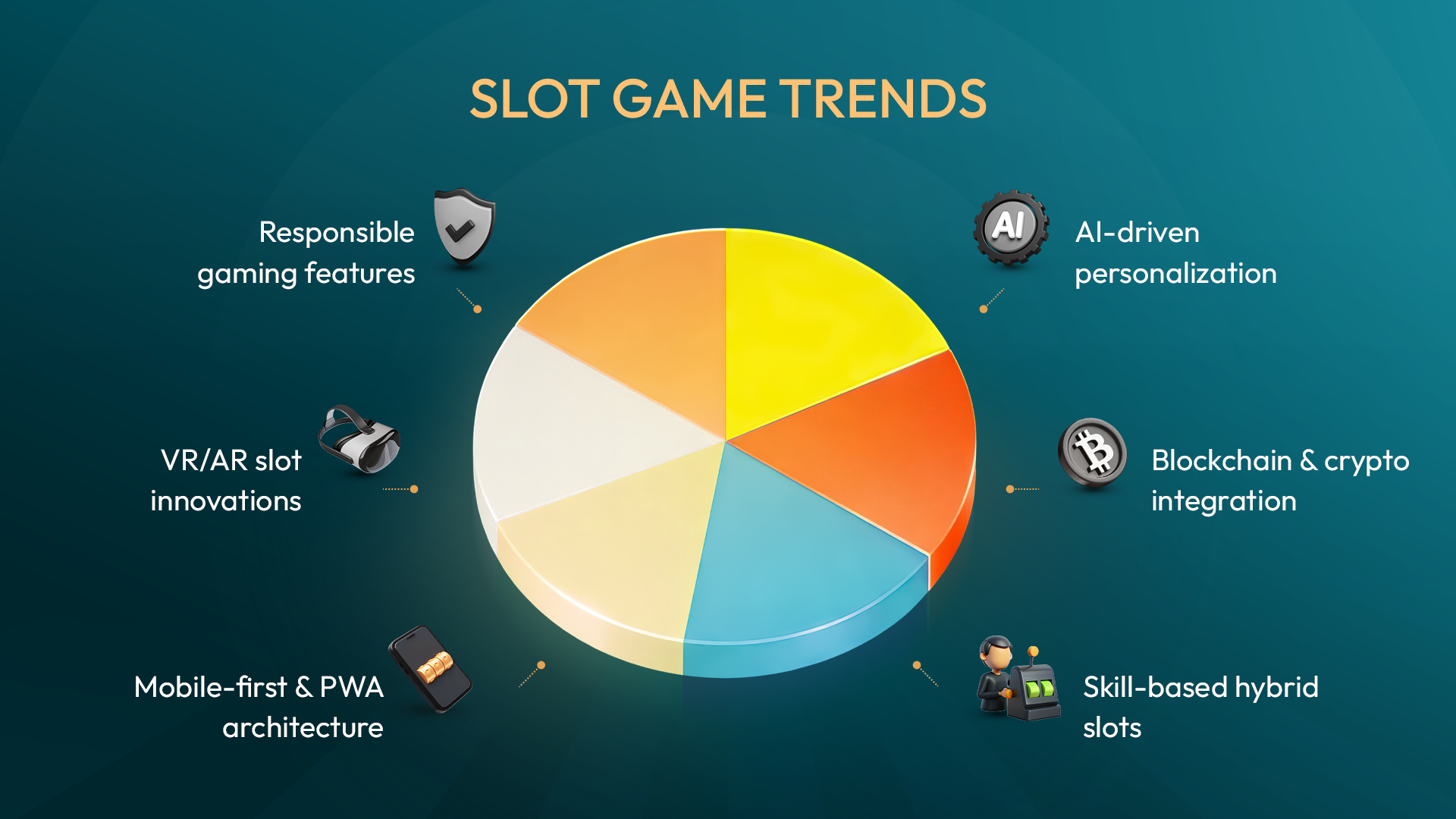
Slot game development trends 2026+
Slot developers have been working hard over the last few years, utilizing new technologies to capture more of the lucrative casino industry and stay ahead of the curve.
Recent innovations may seem minor when compared to the online casino and mobile gaming revolutions, but advancements in artificial intelligence (AI) and blockchain technology, as well as a push toward interactive, social gaming, mean there could be some big changes on the horizon.
So, what slot game trends can we expect to see in 2026 and beyond?
AI-driven personalization
Players are growing weary of the traditional cycle—collect a bonus, play slots, meet wagering requirements, and start again.
It’s a one-size-fits-all approach that lacks nuance, but AI-personalization could change that.
Machine learning algorithms create real-time player groups based on behavior, and by learning how they interact, how and when they play, and what games they prefer, they can then target them with tailored bonuses or even recommend specific games.
The player feels like they’re getting special treatment, and as casinos cater to all of their tastes, they’ll keep playing.
iGaming experts predict a 30-50% increase in key engagement metrics resulting from AI-driven features, and developers are already thinking about how they can incorporate AI into their development, integration, and marketing strategies.
Blockchain & crypto integration
Analysts predict that cryptocurrency technology could skyrocket the iGaming sector to annual revenues of over $500 billion in the near future. It’s a lofty prediction, but it makes sense when you consider that unregulated crypto gambling is thought to generate over $90 billion a year in the USA alone.
With new regulations and adaptations, the crypto gambling space is rapidly changing, and by integrating crypto payments into slots for instant transactions, securing gateways using blockchain technology, and expanding on the ways that players interact with casinos, the industry could reach that hefty $500 billion estimation within a few years.
Skill-based hybrid slots
Slots are predominantly luck-based, but developers are experimenting with mechanics that introduce elements of skill without deviating too much from traditional slot gameplay.
Known as hybrid slots, these titles are more engaging and promote player retention. It remains to be seen whether we’ll see them released on a grand scale, but if so, 2026 could experience a transformation greater even than the first Megaways™ slot or progressive jackpot.
Social competition & gamification
The social casino sector is expected to hit a valuation of over $9 billion in 2026 before climbing to nearly $16 billion by 2033. Not only are these casinos popular in countries with tight gambling regulations, but they also attract low-risk players who want to enjoy games in a more social setting.
By using virtual credits in place of real money and offering gamification features like leaderboards, social casinos have carved out their own niche, and the iGaming sector is learning from their success.
In the coming years, we may see similar features added to slot games and casinos—promoting social gaming, implementing gamification, and attracting social players to real money games.
VR/AR slot innovations
Virtual reality (VR) and augmented reality (AR) are the next step up from live casino gaming. Players don’t just see a live slot or table game on their device—they’ll feel like they can reach out and touch it.
Of course, VR and AR are nothing new, and experts have been predicting a groundbreaking impact for years, but with a greater uptake, as well as the technology to create smooth, lifelike experiences, 2026 could be the year that AR/VR slots hit the mainstream.
Responsible gaming features & compliance automation
Regulations are one of the biggest hurdles in the online casino sector, with developers and operators hiring large teams to manage compliance and stay up to date with ever-changing regulations. AI could make that easier, though.
Machine learning algorithms can study abnormal betting patterns to detect money laundering, fraud, and problem gambling. Once the system raises a red flag, it can then assess risk levels, call for a manual review, or simply act to ban, restrict, or even advise a player.
Processes that now require a team of experienced employees could be handled by a single algorithm that learns and grows with every dataset.
Leading slot game developers and providers
Microgaming is often credited with launching the first online casino in the late 1990s. The studio went on to launch many pioneering technologies (including online progressive jackpot slots), before selling its roster to Games Global, turning the newly established company into a major player overnight.
Other big slot game studios include:
NetEnt
A leader in online slot technologyand the studio behind breakthrough titles like Starburst and Gonzo’s Quest, NetEnt is now owned by the Evolution Gaming Group.
1spin4win
1spin4win is a fast-growing online slot provider with a huge list of classic slots, Hold and Win slots, and more. It offers some of the most consistently high RTPs in the industry, but delivers state-of-the-art math models to ensure profitability for casino operators.
Available via a white-label solution or direct integration, 1spin4win’s extensive roster includes Golden Joker 243 Fortune, Mystical Luck Hold and Win, Lucky Retro Fruits 243, and many others.
Pragmatic Play
Pragmatic Play gave the world Big Bass Bonanza and kick-started a fishing slot trend that still thrives to this day. It also introduced the Drops & Wins promotion, adding must-win jackpots and leaderboards to a host of slots.
Playtech
Playtech is one of the biggest iGaming brands in the world, with table games, poker games, a live casino suite, and hundreds of slots. In Age of the Gods, it owns one of the industry’s largest progressive jackpot systems, and has also produced numerous branded slots, such as The Walking Dead and Breaking Bad.
Yggdrasil Gaming
Yggdrasil provides more than 260 games to over 180 operators, with standout hits that include Vikings Go Berzerk and Valley of the Gods. It also operates the Yggdrasil Masters program, partnering with smaller studios to release games with various themes and styles.
About 1spin4win
1spin4win launched in 2021, combining over 15 years of slot game experience to create eye-catching, nostalgic slots. These games add fresh takes to retro designs, with Retro Mega Fruits offering a massive 1024 paylines, Book of Wild presenting a twist on the “Book Of” theme, and Beersburg Fest Hold and Win combining Hold and Win mechanics with two fixed jackpots.
1spin4win currently has a portfolio of 180+ classic online slots, with new titles released regularly.
Conclusion
Slot game development is a complicated and expensive process. Developers must account for everything from the initial brainstorming and ideation stages to the market research, testing, certification, and actual game design.
However, with slot revenues increasing year-on-year and players hungry for new titles and original ideas, it’s worth the effort and expense for many creators.
FAQs
What is slot game development?
Slot game development is the process of creating a slot machine, from the initial conception, through to market research and development using a series of specialized design, programming, and testing tools.
How much does slot game development cost?
The total cost of slot game development depends on the complexity of the slot, as this impacts everything from labor costs to testing and implementations. Typical costs may exceed $20,000, but for more complicated slots, as well as ones that feature branded themes and licensed features, those costs could run well into six figures.
What are the main types of slot games?
Classic slots and video slots are some of the most common, with the former focusing on simple grids and retro designs and the latter opting for at least five reels and various features.
How to build a slot game?
A good slot game developer will always conduct market research first, seeing what players want and looking at popular games. They will then design the theme using tools like Adobe Photoshop, plot the UI/UX with software such as Adobe XD, and eventually build the game using a programming language or a game engine like Unreal Engine and Unity.
How are slot games programmed?
Slots are programmed using programming languages like HTML5 or a similar game engine to those used in the video gaming sector. In addition to the design and gaming mechanics, slot developers also implement advanced math models and RNGs to guarantee fairness and profitability.
What are the most popular slot features?
Wild symbols and scatters are some of the most common, and you’ll see these on most types of slot games. Free spin rounds lead the way when it comes to unlockable features, and typically promote player engagement and retention by giving them a rewarding bonus to chase.
What algorithm do slot games use?
Online slot games use RNGs to randomize every outcome. These algorithms create a random series of numbers for each spin, and then assign those numbers to specific outcomes. It ensures that every spin is independent of the last and can’t be manipulated by the player or the casino.
How can operators benefit from custom slot development?
Exclusive games are a big draw for players, as experienced gamers have played through classic rosters many times and want games they can’t find anywhere else. Custom games also promote the casino’s brand and can include elements related to its mascot, logo, website, or advertising, along with integrations for specific promotions.
How do casino game developers handle updates and maintenance?
Casino game developers use APIs to seamlessly communicate with platforms, adding new games and updating existing ones as needed. It’s a seamless process that ensures prompt updates for the benefit of everyone involved.
How long does it take to develop a new casino game from scratch?
It depends on the developer and the game, but with the initial research process, followed by design, programming, implementation, and certification, it can take several months. Developers often have several active projects to ensure a steady release schedule.
What features should I look for in an iGaming slot game developer?
Look for a reliable slot provider that offers an eclectic mix of games, regular new releases, occasional promotions, and reliable math models to guarantee profitability while giving players a fair and enjoyable experience.


similar news
similar news
latest interviews



.webp.webp)
Subscribe
Get new case studies and reports directly to your inbox

Oops! Something went wrong while submitting the form.
.webp)
.webp)
Draw inspiration from classics to make your business timeless!